A practical guide to reading battery State of Health, warranty coverage, and range before you buy a used electric car
Buying a used EV raises one question gas-car shoppers never face: how much life is left in the battery? A used gas engine with 80,000 miles is a known quantity. A used EV with 80,000 miles could have a battery barely worn — or one that's lost real range. Here's how to check before you buy.
The battery pack is the most expensive component in an EV, and it's the one system you can't fully judge from a short test drive. Degradation affects your real-world range, the car's resale value, and your risk of an expensive repair. A weak battery can still feel fine around the block and fall short on the highway — which is why checking it is arguably the single most important part of inspecting a used EV.
State of Health, or SoH, is the percentage of a battery's original usable capacity that's still available. A battery at 100% SoH performs like new; one at 85% SoH has lost about 15% of its original capacity.
Don't confuse SoH with State of Charge (SoC) — SoC is just how full the battery is right now. A car can show 100% SoC (fully charged) while sitting at 85% SoH (permanently reduced capacity).
There's no official cutoff for "good" versus "bad." As rough guidance, many owners consider anything above roughly 90% SoH strong for a car's age, while the 70s start to noticeably affect usable range. Treat these as reference points, not standards.
Availability varies significantly by brand, model, and model year — not every method works on every car.
1. Ask for a battery health report, if the seller or dealer has one.
2. Check manufacturer app or dashboard data, where the brand exposes it.
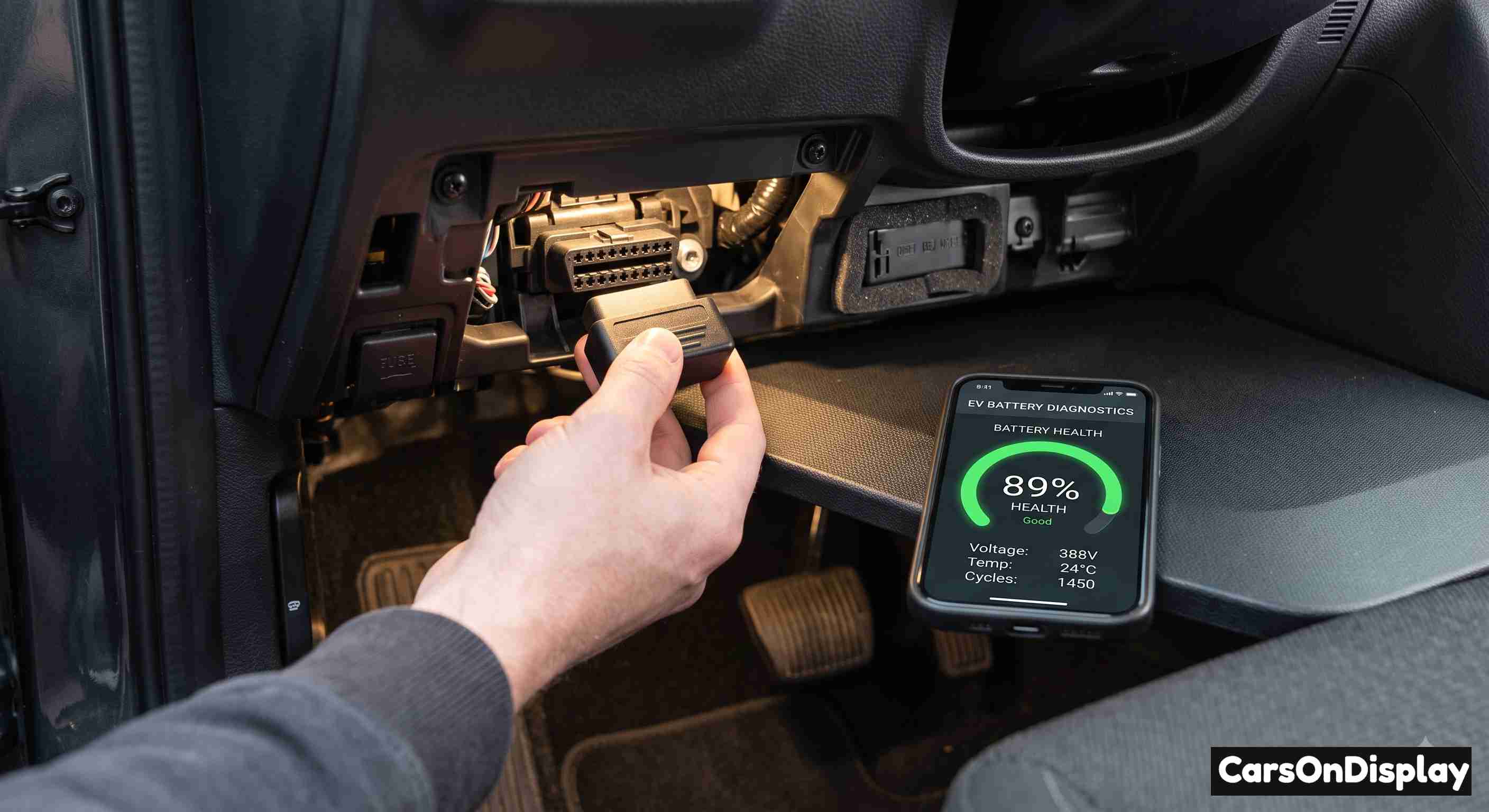
3. Use an OBD-II tool or app, on models that support cell-level data.
4. Compare current range estimates to the original EPA rating.
5. Check charging performance — slow fast-charging or odd charging curves can signal wear.
6. Review charging and usage history, if available from the seller.
7. Get a professional battery inspection, especially for a higher-value purchase.
There's no single number that fits every EV — age, mileage, chemistry, climate, and charging habits all factor in. A percentage that's normal for a five-year-old car might be unusual for a seven-year-old high-mileage one. What matters most is whether the remaining range fits how you'll actually drive the car.
- Note the starting charge and displayed range
- Watch how fast the range estimate drops as you drive
- Ask about recent fast-charging speed and behavior
- Feel for consistent regenerative braking
- Watch for warning lights or battery-related error messages
Partially. You can review dashboard estimates, app data, and service records, and pay attention on a test drive — enough to catch obvious problems. A precise, cell-level SoH reading generally requires an OBD-II tool with a compatible app or a professional inspection, which is worth the cost on a meaningful purchase.
Pricing varies by provider and depth of test. Some manufacturer apps offer free estimates; dealer diagnostics may be bundled into an inspection; independent third-party battery certificates are usually a separate paid service. Confirm current pricing directly with the provider, since it shifts by region.
US federal rules require automakers to cover EV batteries for at least 8 years or 100,000 miles, and states following California's stricter standard extend that to 10 years or 150,000 miles. Most warranties promise repair or replacement if capacity falls below a set threshold, often around 70%, and coverage generally transfers to later owners unless the car was salvage-titled or heavily modified. Check the vehicle's in-service date — not your purchase date — since that's when the clock started.

- Range well below what the reported SoH suggests
- Active battery warning lights
- Abnormally slow fast-charging
- Missing charging or service records
- A seller unwilling to allow an inspection
Usually, yes. Some capacity loss is normal battery aging, not a dealbreaker. Weigh the price against the battery's condition, remaining warranty, your driving needs, and how long you plan to keep the car. A moderately degraded battery priced accordingly, with warranty still active, can be a solid buy — the same battery on an overpriced, warranty-expired car is a different risk.
Battery condition, remaining warranty, and a verified diagnostic reading are the three things worth confirming before you pay. A seller's word isn't a substitute for real data — get the numbers, understand them, and let them shape your offer.
Why Battery Health Matters More Than Mileage
The battery pack is the most expensive component in an EV, and it's the one system you can't fully judge from a short test drive. Degradation affects your real-world range, the car's resale value, and your risk of an expensive repair. A weak battery can still feel fine around the block and fall short on the highway — which is why checking it is arguably the single most important part of inspecting a used EV.
What Is Battery State of Health (SoH)?
State of Health, or SoH, is the percentage of a battery's original usable capacity that's still available. A battery at 100% SoH performs like new; one at 85% SoH has lost about 15% of its original capacity.
Don't confuse SoH with State of Charge (SoC) — SoC is just how full the battery is right now. A car can show 100% SoC (fully charged) while sitting at 85% SoH (permanently reduced capacity).
There's no official cutoff for "good" versus "bad." As rough guidance, many owners consider anything above roughly 90% SoH strong for a car's age, while the 70s start to noticeably affect usable range. Treat these as reference points, not standards.
7 Ways to Check a Used EV's Battery Health
Availability varies significantly by brand, model, and model year — not every method works on every car.
1. Ask for a battery health report, if the seller or dealer has one.
2. Check manufacturer app or dashboard data, where the brand exposes it.
3. Use an OBD-II tool or app, on models that support cell-level data.
4. Compare current range estimates to the original EPA rating.
5. Check charging performance — slow fast-charging or odd charging curves can signal wear.
6. Review charging and usage history, if available from the seller.
7. Get a professional battery inspection, especially for a higher-value purchase.
Reading a Battery Health Report
| Reading | What It Means | What to Look For |
|---|---|---|
| SoH | Current vs. original usable capacity | Weigh against age and mileage |
| SoC | How full the battery is now | Not a health metric |
| Estimated range | Predicted distance on a full charge | Compare to original EPA rating |
| Cell imbalance | Uneven charge across cells | Significant imbalance can signal aging |
| Charging history | Record of past charging habits | Frequent DC fast charging is a wear factor |
What's a Good SoH Percentage?
There's no single number that fits every EV — age, mileage, chemistry, climate, and charging habits all factor in. A percentage that's normal for a five-year-old car might be unusual for a seven-year-old high-mileage one. What matters most is whether the remaining range fits how you'll actually drive the car.
Checking Battery Health on a Test Drive
- Note the starting charge and displayed range
- Watch how fast the range estimate drops as you drive
- Ask about recent fast-charging speed and behavior
- Feel for consistent regenerative braking
- Watch for warning lights or battery-related error messages
Can You Check It Without Special Equipment?
Partially. You can review dashboard estimates, app data, and service records, and pay attention on a test drive — enough to catch obvious problems. A precise, cell-level SoH reading generally requires an OBD-II tool with a compatible app or a professional inspection, which is worth the cost on a meaningful purchase.
What an EV Battery Test Costs
Pricing varies by provider and depth of test. Some manufacturer apps offer free estimates; dealer diagnostics may be bundled into an inspection; independent third-party battery certificates are usually a separate paid service. Confirm current pricing directly with the provider, since it shifts by region.
Check the Battery Warranty
US federal rules require automakers to cover EV batteries for at least 8 years or 100,000 miles, and states following California's stricter standard extend that to 10 years or 150,000 miles. Most warranties promise repair or replacement if capacity falls below a set threshold, often around 70%, and coverage generally transfers to later owners unless the car was salvage-titled or heavily modified. Check the vehicle's in-service date — not your purchase date — since that's when the clock started.
Used EV Battery Red Flags
- Range well below what the reported SoH suggests
- Active battery warning lights
- Abnormally slow fast-charging
- Missing charging or service records
- A seller unwilling to allow an inspection
Is a Degraded Battery Still Worth Buying?
Usually, yes. Some capacity loss is normal battery aging, not a dealbreaker. Weigh the price against the battery's condition, remaining warranty, your driving needs, and how long you plan to keep the car. A moderately degraded battery priced accordingly, with warranty still active, can be a solid buy — the same battery on an overpriced, warranty-expired car is a different risk.
Before You Buy
Battery condition, remaining warranty, and a verified diagnostic reading are the three things worth confirming before you pay. A seller's word isn't a substitute for real data — get the numbers, understand them, and let them shape your offer.
FAQ Questions:
| 1. How do you check the battery health of a used EV? |
| Ask for a battery health report if one exists, check manufacturer app data, compare current range to the original EPA rating, and consider an OBD-II scan or professional diagnostic where the model supports it. |
| 2. What is a good battery health percentage for a used EV? |
| There's no universal number, but many owners view above roughly 90% SoH as strong for a car's age, while the 70s can start affecting daily range. Weigh the percentage against age, mileage, and price. |
| 3. How do I check EV battery State of Health? |
| Through a manufacturer app, a dealer or third-party diagnostic report, or an OBD-II scan tool with a compatible app. Availability depends heavily on the vehicle's brand and model year. |
| 4. Can an OBD-II scanner check EV battery health? |
| On some EVs, yes, with a compatible dongle and app pulling cell-level data. Support varies by manufacturer, so confirm compatibility with your specific model first. |
| 5. How much does an EV battery health test cost? |
| It ranges from free manufacturer app estimates to paid dealer or third-party diagnostic reports. Confirm current pricing directly with the provider, since it varies by region and test depth. |
| 6. How can I tell if a used EV battery is bad? |
| Watch for range well below the reported SoH, slow fast-charging, warning lights, missing service records, and a seller unwilling to allow an inspection. |
| 7. Should I buy a used EV with battery degradation? |
| Often, yes. Moderate degradation is normal and not automatically a dealbreaker, as long as the price reflects the battery's condition and the remaining range fits your driving needs. |














 10 Most Powerful Chinese EVs in the World 2026
 Why Body-on-Frame Off-Roaders Are Making a Comeback in 2026
 How to Check a Used EV's Battery Health Before Buying
 Top 5 Fastest Pickup Trucks in the World (2026)
 Best Extended Car Warranty Companies of 2026: Top 10 Ranked
 Top 10 Fastest Sedans in the World - 2026 List
 Top 10 Best Electric SUVs in the World 2026
 Best Used Electric Cars Under $20,000 in 2026